

Why Vinyl Records Crackle: Dust Isn’t the Real Culprit
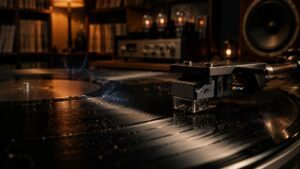
You pull out an LP record, set the needle down, and within seconds you hear it – that familiar snap, crackle, and pop layered beneath the music. Most people assume dust is the villain. And sure, dust plays a role. But if dust were the only problem, a quick wipe-down would fix everything. It doesn’t. So what’s really going on?
The truth behind vinyl crackle is more interesting than most people realize, and understanding it can change how you think about records.
The Real Reason Vinyl Records Crackle
It Starts With the Groove
A phonograph record works by storing sound as a physical groove cut into the vinyl surface.
When a stylus runs through that groove, it reads the tiny variations carved in during the mastering (audio) process and converts them back into sound. That’s the whole mechanism – elegant, analog, and surprisingly fragile.
Every time that groove is played, friction happens. The stylus drags through the channel, and each pass causes microscopic wear. Over hundreds of plays, those walls degrade. What was once a clean, high-fidelity signal becomes rougher, introducing noise that wasn’t there in the original recording.
This is why a well-played record from the 1960s crackles more than a lightly played copy of the same pressing. The groove itself has been physically damaged by repeated contact.
Static Electricity Is a Bigger Problem Than Dust
Here’s where most people get confused. Vinyl, as a material, is highly susceptible to static electricity. When you pull a record out of its sleeve, or when the stylus moves through the groove, the friction generates a static charge. That charge acts like a magnet for airborne particles.
So yes, dust ends up on your records. But static electricity is often what pulled it there in the first place – and static on its own creates noise even on a clean surface. It’s one of the most overlooked sources of sonic artifacts in vinyl playback, and no amount of wiping fixes it without addressing the charge itself.
Pressing Quality and the Vinyl Formula
Not all records were created equal. In parts of the 1970s and 1980s, manufacturers reduced vinyl quality to cut costs. The oil crisis made petroleum-based materials more expensive, and some labels responded by using recycled or lower-grade compounds.
Records pressed from inferior materials introduced noise at the moment of manufacturing. That crackle was baked in before the record ever reached a turntable. This is why two different pressings of the same album can sound dramatically different – one might approach near-digital clarity, while the other sounds like it’s playing through a paper bag.
Collectors who know their pressings – members of communities like the Other Vinyl Record Collectors Club – understand that early pressings from certain labels, including Atlas Records, often hold superior sound quality compared to later budget reissues.
What Actually Damages Records Over Time
Surface Debris and Improper Storage
Debris that gets embedded in the groove is far more damaging than surface dust. Small particles of grit, paper fibers from old sleeves, or residue from improper cleaning act as abrasives. Every play grinds them deeper.
Improper storage compounds the problem. Records stored horizontally stack on top of each other. Over the years, this causes warping. A warped record doesn’t track evenly, which means the stylus bounces and skips – introducing mechanical noise that has nothing to do with the original recording.
Stylus Wear and Tracking Force
A worn or damaged stylus doesn’t just play poorly – it actively destroys grooves. A blunt needle drags and gouges rather than tracing cleanly. Many people inherit collections where a single bad needle caused more damage than decades of normal playback.
Tracking force matters too. If the tonearm is set too heavy or too light, the stylus either digs in aggressively or skates across the surface erratically. Either way, the groove pays the price.
Age, Chemistry, and Oxidation
Vinyl doesn’t oxidize the way metal does, but it does react to its environment over time.
Exposure to UV light, extreme temperature changes, and certain chemicals in old inner sleeves can cause the surface to become brittle or develop a haze that interferes with playback.
This type of degradation produces a softer, more continuous crackle rather than sharp pops. It’s a different sound from static or groove damage, and it often signals that a record is approaching the end of its playable life.
How Vinyl Crackle Compares to Other Formats
It’s worth stepping back and acknowledging why this matters in the context of sound recording and reproduction as a whole. The compact disc was marketed heavily in the 1980s and 1990s as the solution to all of this. Digital data doesn’t wear, doesn’t attract static, doesn’t warp. Pop music shifted formats almost entirely.
The cassette tape had its own noise problems – hiss, dropout, speed fluctuation – addressed partially by noise reduction systems like Dolby. But tape degraded in its own ways.
Vinyl outlasted predictions of its death precisely because listeners noticed something: the noise of a record, when it comes from a well-pressed, well-maintained LP, has a character that doesn’t feel like damage. Think of the faint room ambience on a track like “Pale Blue Eyes” by The
Velvet Underground – analog warmth that digital formats replicate but don’t quite capture.
That said, the crackle that comes from neglect, damage, or poor pressing is a different matter entirely. It obscures the music rather than enhancing it.
Why Vinyl Records Crackle and How to Reduce It
Noise reduction tools exist, both hardware- and software-based, that can minimize surface noise. Ultrasonic cleaning machines remove embedded debris without damaging the groove.
Anti-static devices and inner sleeves help manage the static electricity problem.
But none of these fully restore a groove that’s already been worn down by friction. That damage is permanent. The phonograph has no “undo.”
This is why condition matters so much to collectors. A record that has been stored properly, played on a well-maintained turntable, and kept clean retains its value – both sonically and monetarily.
Why Vinyl Records Crackle: Dust Isn’t the Real Culprit
Vinyl crackle comes from a combination of groove wear, static electricity, debris, pressing quality, and age – not just dust. Understanding these causes helps you protect the records you have. And if you’ve come across a collection that’s been sitting untouched for decades, those records may be in better shape than you think. If you’re curious about what your vinyl is actually worth, learn more about how Cash For Records buys vinyl collections or call us at 216-315-8216 to get started.