
The Best Way to Store Vinyl Records So They Hold Their Condition and Value
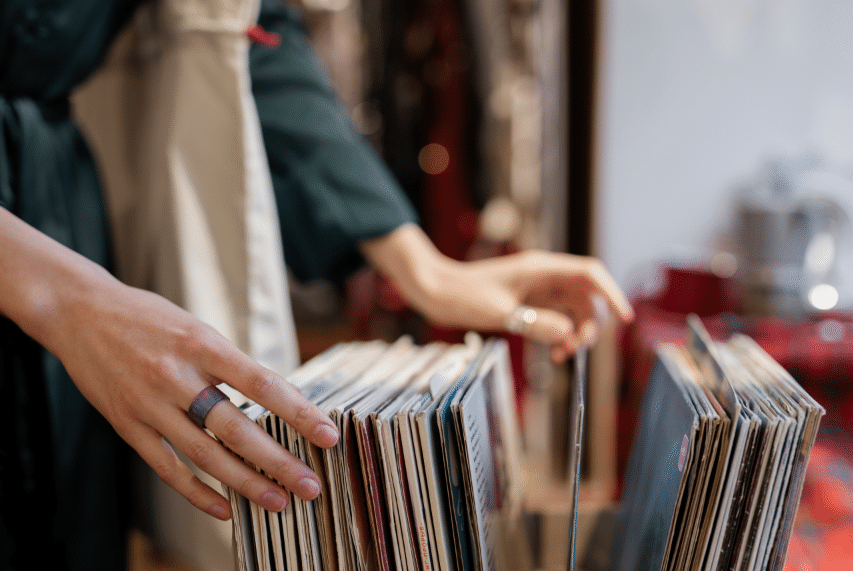
Store records upright, packed snugly, somewhere cool and dry, in both an inner and an outer sleeve. Everything else is detail. Our family has bought collections through Cash For Records since 2001, and storage decides more of what we pay than most sellers expect. Two identical pressings can sit forty dollars apart on condition alone. People who want to safely sell vinyl records later should treat the shelf as part of the asset. Check how yours are sitting right now, because leaning stacks warp in months, not years.
Upright and Snug, Never Stacked Flat
Records belong on their edges, standing vertically like books. Lay them flat and the weight of the stack presses down on the discs at the bottom. The pressure builds slowly, so the damage never announces itself. Pull a record from the bottom of a flat stack after a year and you often find a dish warp across the whole face.
Leaning is the other half of the problem. A half-empty shelf lets records tilt, and a tilted record holds that curve permanently. The vinyl takes a set the same way a bent card does. Pack the shelf so everything stands square, and use a bookend or a filler block when a row runs short.
Snug has limits though. Jam records in so tightly that you have to wrestle one free. You will scuff the sleeve edges every time you pull a title. Aim for enough pressure to hold everything upright and enough slack to slide one out with two fingers. That balance is easy to feel once you try it and hard to describe on paper.
Shelf height matters more than people think. A shelf that holds a few hundred records carries real weight, and a sagging shelf tilts everything on it. Check that any unit you use is rated for the load. Keep records at waist height or above if the floor ever takes water.
Heat and Humidity Do the Damage You Cannot Undo
Florida is hard on vinyl, and the garage is the worst room in the house. Heat softens the disc and warping follows, often from a single afternoon. A car trunk or an attic in July will ruin a box of records in a day. We have opened garage boxes around Jacksonville, FL and found a third of the collection dished.
Humidity works slower and does more lasting harm. Damp air gets into paper sleeves and jackets, and mold follows once the moisture settles in. Mold leaves a haze on the vinyl and staining on the cardboard, and the stains do not come out. A record that plays fine inside a moldy jacket still loses value, because the jacket is graded on its own. Our piece on what temperature damages vinyl records covers the heat side in more detail.
Interior rooms with air conditioning solve both problems at once. A closet on an inside wall, a spare bedroom, or any space the household already keeps comfortable will do. Avoid exterior walls where condensation forms, and keep records off concrete floors entirely, since slab moisture wicks upward into the bottom of a box.
Sunlight deserves its own mention. Direct sun fades jacket artwork quickly and heats the vinyl behind it at the same time. A collection displayed on a sunny wall loses jacket value first and disc value second. Move anything sitting in a window, and draw the blinds on the hours when the sun hits that side of the house.
Sleeves Are the Other Half of the Grade
Every record wants two layers. An inner sleeve protects the disc surface, and an outer sleeve protects the jacket. Most collections we see have one or the other, rarely both, and the gap shows in the grades we give.
Original paper inner sleeves are the quiet culprit in a lot of collections. Paper sheds fibers and holds grit, and the card stock ones have a seam that drags across the playing surface. Those fine scuffs accumulate every time the record goes in or comes out. Anti-static poly-lined inners cost little and stop that process outright. Keep the original paper sleeve inside the jacket behind the record, since it often carries label artwork or lyrics that belong with the release.
Outer sleeves protect the part of the record a buyer sees first. Ring wear, seam splits and shelf scuffs all happen at the jacket edges, and a clear outer sleeve absorbs that wear instead. They also keep neighboring jackets from abrading each other as records slide in and out. For anything you suspect is worth money, the outer sleeve pays for itself the moment a buyer looks at the collection.
What Storage Damage Costs at Grading Time
Our buyer grades each record twice, once by eye under a strong light and once on a turntable. Storage damage shows up in both passes. Some of it is cosmetic, and some of it is terminal, and knowing which is which helps you decide what to protect first.
Here is what we find most often, and what it does to a grade.
| Storage Failure | What It Produces | Effect on Value |
|---|---|---|
| Flat stacking or leaning | Dish or edge warp | Severe, often unsellable |
| Garage or attic heat | Warping and sleeve glue failure | Severe |
| Damp air or concrete floors | Mold haze and jacket staining | Severe, rarely reversible |
| Paper inner sleeves | Fine surface scuffs and crackle | Moderate, lowers the play grade |
| No outer sleeve | Ring wear, seam splits, shelf scuff | Moderate, lowers the jacket grade |
| Direct sunlight | Faded artwork, heat warp | Moderate to severe |
Warping is the one that ends the conversation. A dished record skips or rides the stylus off the groove, and no cleaning fixes the shape. Mold runs a close second, since the haze bonds to the vinyl and the staining soaks into cardboard. Surface scuffs and jacket wear are survivable and show up as a step or two down the scale. If you’re unsure where a record falls on that scale, our Vinyl Record Appraisal service can pin down its true condition and value. Our page on vinyl record grading walks through how the scale runs from Mint to Poor.
Condition interacts with rarity rather than replacing it. A scarce pressing in rough shape can still be worth more than a common title in clean shape. What good storage does is keep the ceiling intact, so the record is worth whatever its rarity and demand say it is worth.
Worried the Shelf Has Already Cost You Money?
Our buyer can tell you what survived and what did not, in person, before you touch a cloth or move a box. The collection stays exactly where it is until you decide what to do with it.
Checking Stored Records Before a Buyer Visits
Collections that have sat untouched for years deserve a look before anyone schedules anything. You are not grading and you are not cleaning. You are finding out whether the storage held up, which changes what you can tell us.
Pull ten or twelve records from different parts of the collection, including the bottom of any flat stack. Hold each one at eye level and sight across the surface for a dish or ripple. Check the jackets for soft spots, water lines along the bottom edge, and any musty smell when you open the sleeve. A smell usually means mold somewhere, even if nothing is visible yet.
Leave the cleaning to the appointment. Household products and improvised fixes cause more damage than they repair. A record that arrives wet from a rushed clean grades worse than one left alone. Mold in particular needs careful handling rather than a quick wipe, and we have written about removing mold from a record separately. Tell us what you found and let our buyer assess it in person.
Shelving, Crates and Boxes That Work
You do not need specialist furniture. A sturdy cube unit, a reinforced bookcase, or purpose-built record crates all work, provided the shelf is deep enough and strong enough. Depth matters because a 12 inch jacket needs a little over twelve inches of clearance and a flush fit scuffs the spines.
Check any storage you are using against this.
- Shelf depth clears 13 inches, so jackets sit fully inside without rubbing the edges
- The unit is rated for the weight, since a few hundred records runs heavier than books
- Records sit above floor level, which keeps them clear of slab moisture and flooding
- Rows are divided every foot or so, so no section leans when records come out
- Nothing sits against an exterior wall, where condensation and heat transfer are worst
Plastic bins with lids seem sensible and often are not. A sealed bin traps humid air with the records inside, and in this climate that is how mold starts. If you need boxes, use rigid cardboard or crates that breathe, keep them upright, and store them in conditioned space. Never fill a box so heavy that it sags when lifted, because that sag transfers straight into the discs.
Worried the Shelf Has Already Cost You Money?
Our buyer can tell you what survived and what did not, in person, before you touch a cloth or move a box. The collection stays exactly where it is until you decide what to do with it.
Frequently Asked Questions About Storing Vinyl Records
Sellers ask much the same things once they start worrying about condition. The answers below cover what actually protects value, rather than what looks tidy on a shelf. None of it needs special equipment or a weekend of work.
Should vinyl records be stored flat or upright?
Upright, standing on their edges like books. Flat stacking puts the weight of every record onto the ones below, which produces a dish warp over months. Store them vertically, packed snugly enough that nothing leans, with a divider or bookend wherever a row runs short of filling the shelf.
What temperature and humidity are safe for vinyl?
Normal indoor comfort conditions work well for records. A room the household already keeps cool and dry is fine, which rules out garages, attics and sheds in Florida. Heat softens vinyl and causes warping, while damp air feeds mold in sleeves and jackets. Interior rooms on air conditioning are the safest choice.
Do I need both inner and outer sleeves?
Both do different jobs. An anti-static poly-lined inner sleeve stops the fine scuffing that paper sleeves cause, which protects the play grade. A clear outer sleeve absorbs ring wear and seam damage, which protects the jacket grade. Records are graded on disc and jacket separately, so each layer protects a different part of the value.
Can a warped record be saved?
Usually not in a way that restores value. A warp is a change in the shape of the vinyl, and heat-based flattening methods carry real risk of making things worse. Mild dish warps sometimes still play. Severe warps skip or throw the stylus and generally have little resale value, whatever the title.
Does storage really change what a buyer pays?
Yes, often substantially. Artist, pressing, rarity and demand set the range a record can reach, and condition decides where inside that range it lands. Two copies of the same pressing can sit far apart on price. One was kept upright in sleeves, the other spent a decade flat in a garage.
Have Our Buyer Look at What the Shelf Did
Tell our team roughly how many records you have and which genres dominate. Mention where the collection has been kept, and anything the spot check turned up, including warps, stains or a musty smell. That picture is enough for us to say whether a visit makes sense.
We buy jazz, blues, soul, R&B, rock, punk and metal across LPs, 45s, 78s and 12 inch singles. Country, big band, swing and pop are outside what we handle right now. House calls run across Jacksonville, FL and the surrounding markets, and payment is cash on the spot for whatever fits.
Ready to Have Your Record Collection Evaluated?
Tell Paul Robinson roughly how many records you have, which genres dominate, and where the collection has been kept.
We make house calls across Jacksonville, FL, Jacksonville Beach, and Duval County, and pay cash on the spot for whatever fits.