

Shellac Records Vs Vinyl: What’s the Real Difference and Which Sounds Better?
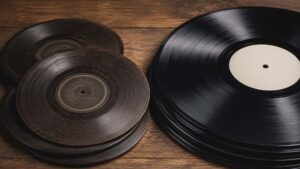
If you’ve ever dug through a box of old records and noticed some felt heavier, thicker, and weirdly fragile compared to the others, you were probably holding a shellac record. And if you’ve ever wondered what separates these older discs from the vinyl records people collect today, you’re not alone.
The difference goes deeper than just materials. It touches on history, sound quality, playback, and the evolution of recorded music itself.
What Are Shellac Records, Exactly?
Shellac is a natural resin secreted by the lac bug, primarily found in parts of Asia. When used in record production, shellac resin was mixed with various fillers like limestone, cotton, and carbon black to create a hard, brittle disc.
These were the dominant format for phonograph records from the late 1800s through the late 1940s. The production of shellac records peaked during the early 20th century, long before anyone had figured out a better way to mass-produce recorded music at scale.
The standard shellac record spun at 78 rpm – that’s 78 revolutions per minute – which is why you’ll hear these old records referred to as 78s, seventy-eights, or simply 78 rpm records.
A Quick History: From Cylinder to Flat Disc
Before the flat disc record became the standard, people were listening to music on a phonograph cylinder. Thomas Edison’s early sound recording technology used a cylinder format, and companies like Edison Records even produced Blue Amberol Records, which were cylinder-based and made from celluloid rather than shellac.
But the flat disc won out. By the early 20th century, companies like Columbia Records, RCA, and Decca Records had adopted the disc record format as the industry standard. The phonograph evolved from purely acoustical playback to electrical recording (using microphones and amplifiers), and later to recording techniques that involved magnetic tape.
The War Production Board during World War II restricted the supply of shellac for civilian use since it was needed for military equipment. This pushed the industry to start experimenting with alternative vinyl material well before it was ready for mass production.
How Shellac and Vinyl Records Are Made Differently
The gap between shellac and vinyl is not just about what they’re made of. It’s about what that material allows engineers and manufacturers to do.
Shellac discs are fragile. Drop one on a hard floor, and it shatters. The groove cut into a shellac disc is relatively wide, requiring steel needles for playback – needles that would chew through a modern vinyl record in minutes.
Vinyl, specifically PVC (polyvinyl chloride), is far more flexible and durable. It allowed for a much finer microgroove, which changed everything. A narrower groove meant more information could fit on a disc, which led directly to longer playing times.
The Big Format Shift: 78 RPM to LP and 45
By the late 1940s, Columbia Records introduced the LP record spinning at 33 1/3 rpm. The LP – short for long-playing records – could hold around 20 to 30 minutes of music per side, compared to the three to five minutes of music you’d get from a shellac 78.
RCA responded by introducing the 45 rpm format, a smaller 7-inch disc that became the home of singles. Both of these new records were made from vinyl rather than shellac, and both used the microgroove format that dramatically improved fidelity.
By the late 1950s, vinyl took the spotlight completely. The shift from shellac to vinyl was driven by practicality: vinyl was cheaper to produce, lighter, more durable, and capable of supporting stereo sound and a wider frequency range.
Sound Quality: Shellac Vs Vinyl – Which Actually Sounds Better?
This is where things get genuinely interesting. The honest answer is that it depends on what you’re comparing and what condition the records are in.
- Shellac’s sound quality has limitations built into its format. The wider groove, the speed at which 78 rpm discs spin, and the materials used in the disc itself all contribute to more surface noise and a narrower sonic range. Acoustical recordings from the early shellac era sound noticeably thin compared to modern vinyl, though electrical recordings from the 1930s and 1940s can still sound remarkably vivid.
- Vinyl’s sound quality benefits from quieter surfaces, finer grooves, a broader frequency range, and improved mastering techniques. The LP’s ability to hold longer playing times also changed how artists structured albums, which had a real effect on music as an art form.
That said, some audiophiles will argue that a pristine shellac 78 played through a properly calibrated turntable with the right stylus can have a warmth and character that modern pressings sometimes lack. It’s not just about fidelity – it’s about the character of the sound, including the sonic artifact of the format itself.
The EQ curves used in playback also differ between formats, so a shellac 78 played on a modern record player without proper adjustment won’t sound its best. You need the right gear to give these older records a fair hearing.
What Makes Shellac Records Collectible Today
Despite their fragility, 78 rpm records carry enormous historical and musical value. Early jazz, blues, country, and classical recordings exist only on shellac discs. If you want to hear Bessie Smith or Robert Johnson as they were originally recorded, you’re listening to shellac.
Collectors who specialize in 78s know that a clean, uncracked disc record in excellent condition can be extraordinarily rare and worth serious money. The same is true for certain early acetate disc recordings used in radio broadcasting before commercial pressings were available.
If you’ve inherited or discovered a collection of old records and you’re not sure what you’re holding, it’s worth taking a closer look. Those thick, heavy discs with a label from Columbia Records, Decca Records, or another early imprint could be quite valuable – especially if the grooves are clean and the shellac surface is intact.
How to Tell Shellac from Vinyl at a Glance
You don’t need to be an expert to tell them apart.
- Shellac records are heavier and more brittle. They feel dense and will snap if bent.
- Vinyl records are lighter and more flexible. You can bend them slightly without breaking them.
- Shellac 78s are typically 10-inch or 12-inch discs spinning at 78 rpm.
- Vinyl LPs are usually 12-inch and spin at 33 1/3 rpm, while 45s are 7-inch discs.
- Labels on shellac records often feature older graphic styles and pre-1950 catalog numbers.
When in doubt, a careful visual inspection of the label and a gentle flex test (without forcing it) will usually tell you what you’re dealing with.
What to Do If You Have Old Shellac or Vinyl Records
Whether you’ve found a stack of 78s in a relative’s attic or you’re sitting on a collection of LPs you no longer play, those records have real value to the right buyer. Cash For Records has been buying vinyl and other collectible records since 2001, and the team knows how to evaluate everything from rare shellac 78 rpm records to sought-after modern vinyl pressings.
If you’re in the Cleveland area and you’re not sure what your collection is worth, reaching out for an honest evaluation costs you nothing. The process is straightforward, and there’s no pressure involved.
Conclusion
Shellac and vinyl represent two distinct chapters in the history of recorded music – each with its own strengths, limitations, and loyal fans. Shellac brought music to the masses in the early 20th century, while vinyl expanded what records could do in terms of duration, fidelity, and format. If you’re sitting on old records and wondering what they’re worth, Cash For Records is here to help. Call 216-315-8216 or visit cashforrecords.com to get a straightforward, honest offer from people who genuinely love music.