

Yes, Your Old Vinyl Records Still Spin on New Turntables
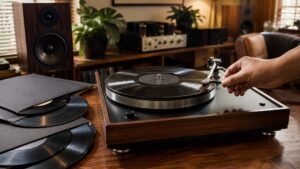
So you found a crate of old records in the attic. Maybe they belonged to a parent or grandparent, or maybe you bought them years ago and forgot about them. Now you’re staring at a stack of LPs and wondering: can you even play these things anymore? Do you need some ancient machine from a thrift store, or will a modern turntable actually work?
The answer is yes – your old vinyl records can absolutely play on new turntables. But there are a few things worth understanding before you drop the needle.
How Vinyl Records and Turntables Actually Work
A vinyl record is a type of phonograph record – a disc with a spiral groove cut into its surface.
When you place it on a turntable, a tiny needle called a stylus traces that groove and picks up the vibrations stored in it. Those vibrations travel through a magnetic cartridge and eventually become the music you hear through your speakers.
This basic mechanism has not changed since the days of the original phonograph. The physics of it is remarkably simple, and that simplicity is exactly why old records still work on new equipment.
The Key to Compatibility: Revolutions Per Minute
Here is where people sometimes get confused. Not all vinyl records spin at the same speed.
The speed is measured in revolutions per minute, or RPM, and it matters a lot.
Most full-length albums – what collectors call LPs – spin at 33 1/3 RPM. The 45 RPM format became the standard for singles, those smaller records with one song on each side. Older records, especially those from the early days of recorded music, often spun at 78 RPM. This format predates modern vinyl and was common before the LP was introduced.
Most new and old turntables handle 33 1/3 and 45 RPM without any issue. Some also include a 78 RPM setting, though that is less common. If you have a collection that spans multiple eras, it is worth checking the specs on any turntable you buy.
Why Old Records Play Just Fine on Modern Equipment
The vinyl record format was standardized decades ago and has stayed remarkably consistent.
A record pressed in the 1950s uses the same basic groove geometry as one pressed today. The stylus on a modern turntable is designed to fit that groove, and the magnetic cartridge converts those physical vibrations into an electrical signal the same way it always has.
Think of it like a standard screw and screwdriver. The design has been consistent for so long that old and new tools still fit together. Vinyl works the same way.
One Thing to Watch: Stylus Size
There is one small technical detail worth mentioning. Records pressed at 78 RPM have a slightly wider groove than modern vinyl. If you want to play a 78, you may need a stylus designed for that format. Playing a 78 with a modern stylus meant for 33s and 45s can damage both the record and the needle.
For most people with standard LP and 45 collections, this is not an issue. But if you inherited records from someone who collected early 20th-century music, it is something to keep in mind.
What About the Condition of Old Records?
A record can play perfectly well on a new turntable even if it looks old. Light surface marks and some dust are normal and do not necessarily affect playback. Deep scratches, warping, or mold are more serious problems.
Before playing anything, give the record a gentle clean. A soft brush or a basic record cleaning solution can remove dust and debris that would otherwise cause skipping or distortion. Proper storage over the years makes a significant difference in how playable old records are today.
What Makes an Old Record Valuable?
Not every record that plays well is worth keeping for personal use. Some are worth quite a bit of money. Jazz albums from artists like Miles Davis or John Coltrane, early rock and soul pressings, and rare label variants can carry real collector value.
A first pressing of a classic album – something that was cut and manufactured close to the original release date – often commands significantly more than a later reissue. The condition of both the record and its sleeve matters enormously.
Record collectors and disc jockey communities have long tracked down original pressings for their superior sound quality, which adds to their desirability and value.
Should You Play Old Records or Sell Them?
This is a fair question. If you have a large collection and are not sure what you have, it may be worth getting an expert opinion before you start spinning everything.
Some records are collectibles that increase in value when left unplayed and well-stored.
Running a valuable first pressing on a cheap turntable with a worn stylus is not ideal. On the other hand, if the records have minimal collector value, enjoy them. That is what music is for.
If you have inherited a collection or uncovered one in a basement or attic, a professional evaluation can tell you quickly which records are worth money and which are everyday listening copies.
Can You Play Old Vinyl Records on New Turntables?
Old vinyl records and new turntables are more compatible than most people realize, thanks to a format that has stayed consistent for generations. Whether you are rediscovering music from decades past or sitting on a collection you are not sure what to do with, the records are almost certainly still playable.
If you think some of those records might be worth real money, reach out to Cash For Records at 216-315-8216 – a family-run business that has been helping collectors turn vinyl into cash since 2001.