

Can WD-40 Clean Vinyl Records?
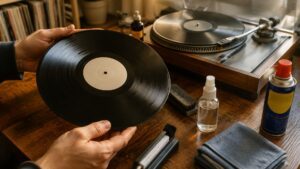
If you’ve stumbled across a dusty crate of old records and noticed some look grimy or scratchy, you might be tempted to reach for whatever’s under the sink. WD-40 has a near-mythical reputation as a fix-all product, so it’s not surprising that some people wonder whether it can rescue a dirty or skipping vinyl record. The short answer is no – and using it could permanently destroy a record you might otherwise have saved.
Let’s break down exactly why WD-40 is a bad idea for vinyl, what actually works, and how to think about cleaning records properly.
What Is WD-40 Actually Made Of?
Most people think of WD-40 as a lubricant, but it’s technically more of a water-displacing spray.
The name stands for “Water Displacement, 40th formula.” It was originally developed in the 1950s to prevent rust on aerospace components. Its primary ingredients include petroleum-based oils, alcohols, and various hydrocarbon compounds.
That chemical composition works beautifully for loosening corroded bolts or protecting metal surfaces. But vinyl records are a different story entirely.
Why WD-40 Is Bad for Vinyl Records
Vinyl records are made from polyvinyl chloride, or PVC – a plastic that reacts poorly to petroleum-based solvents. When you spray WD-40 onto a record, the oils don’t just sit on the surface. They penetrate into the microscopic grooves where the audio information lives.
It Leaves a Residue That Attracts More Dirt
WD-40 is oily by nature. Once it gets into the grooves of a record, it acts like a magnet for dust and debris. Even if it temporarily seems to improve playback, you’re essentially coating your record in a substance that will accumulate grime faster than before. The problem gets worse over time, not better.
It Can Degrade the Vinyl Itself
The petroleum distillates in WD-40 can chemically interact with PVC over time. This can cause the material to soften or become brittle, potentially warping the record or making the groove walls collapse. For any record with real value, whether sentimental or monetary, that kind of damage is irreversible.
It Can Damage Your Stylus
Even if a WD-40-treated record doesn’t visibly deteriorate immediately, playing it on your turntable introduces that oily residue to your stylus (the needle). A contaminated stylus won’t track grooves accurately, which leads to distorted sound and accelerated wear – both on the needle and the record itself. Replacing a quality stylus isn’t cheap, and the damage can quietly spread to other records in your collection.
The Myth Behind Using WD-40 on Records
Every so often, someone claims that WD-40 “fixed” their skipping record or made a scratched album playable again. There are even old forum threads from the early days of the internet where people swore by it. So where does this idea come from?
The partial truth is that WD-40 can temporarily fill in minor surface irregularities, which might reduce skipping on a very lightly damaged record. The stylus essentially rides on a thin film of oil rather than dragging against a rough surface. But this is a short-term trick with long-term consequences. You’re trading a temporary fix for permanent damage.
It’s a bit like putting tape over a crack in your windshield. It might hold for a day, but it’s not a solution.
So What Actually Cleans Vinyl Records?
The good news is that safe, effective methods for cleaning records are well-established and not complicated. The core goal is to remove dust, oils, and debris from the grooves without introducing anything that could cause chemical damage.
- Distilled water and a small amount of dish soap are a budget-friendly starting point for surface grime. The key is using distilled rather than tap water, since tap water contains minerals that can leave deposits in the grooves. Use a microfiber cloth or a soft record cleaning brush, work in the direction of the grooves (not across them), and let the record dry fully before playing.
- Record cleaning solutions sold specifically for vinyl are a step up. These are formulated to clean grooves safely without leaving residue. Brands like LAST, Spin-Clean, and Audio-Technica make reliable products that are widely available online or at record shops.
- Record cleaning machines are the gold standard. These use a combination of fluid and vacuum suction to deep-clean grooves without any manual scrubbing. They’re an investment, but if you’re dealing with a large collection or valuable records, they’re worth considering.
For a more thorough walkthrough of safe techniques, the guide on cleaning vinyl records is a solid resource that covers everything from basic maintenance to deeper cleaning methods.
What If the Record Is Already Damaged?
If someone has already applied WD-40, or any petroleum-based product, to a record, the situation is more complicated. You can try cleaning it thoroughly with an appropriate record cleaning solution to remove as much residue as possible.
Some collectors have had partial success using isopropyl alcohol (in very diluted form, around 25% or less) to cut through oily buildup, but this carries its own risks and should be done carefully.
Honest advice: if the record is a common pressing with low monetary value, it may not be worth the time. But if it’s a rare pressing or a sentimental piece, consulting a professional cleaner or a knowledgeable record dealer is a smarter move than experimenting further.
Does Record Condition Affect Value?
Absolutely – and this matters if you’re thinking about selling. Records in poor condition, especially those with chemical damage or heavy residue, are typically worth very little even if the title itself is desirable. A collectible Miles Davis pressing in near-mint condition might fetch a high price. That same album with damaged grooves and a sticky surface? Significantly less, or nothing at all.
If you’ve inherited a collection or found records in storage, resist the urge to “fix” anything before you know what you have. Well-intentioned cleaning attempts with the wrong products have ruined records that could have been worth real money.
According to the Library of Congress, proper storage and handling are among the most important factors in preserving recorded sound – and the guidance consistently warns against using any non-approved cleaning agents on vinyl.
The Bottom Line
WD-40 has no place near a vinyl record. It won’t clean it, it won’t fix it, and it certainly won’t improve its sound over time. What it will do is leave behind an oily, groove-clogging residue that attracts dirt, risks chemical damage to the PVC, and can ruin your stylus in the process.
If you have records that need attention – whether they’re dirty, damaged, or you’re simply curious about what they’re worth – the smartest first step is to handle them carefully and get a proper assessment. Cash For Records has been evaluating vinyl collections since 2001, and the team knows exactly how to spot records with real value.
If you’re sitting on a collection and wondering what to do next, give us a call at 216-315-8216 for an honest, no-pressure evaluation.